Data science and ML application
Credit Risk Explorer
An educational app that turns applicant details into an explained credit-risk estimate.
- Role
- Data science · applied machine learning
- Date
- Nov 2025
- Stack
- Python · XGBoost · scikit-learn · Streamlit · pytest
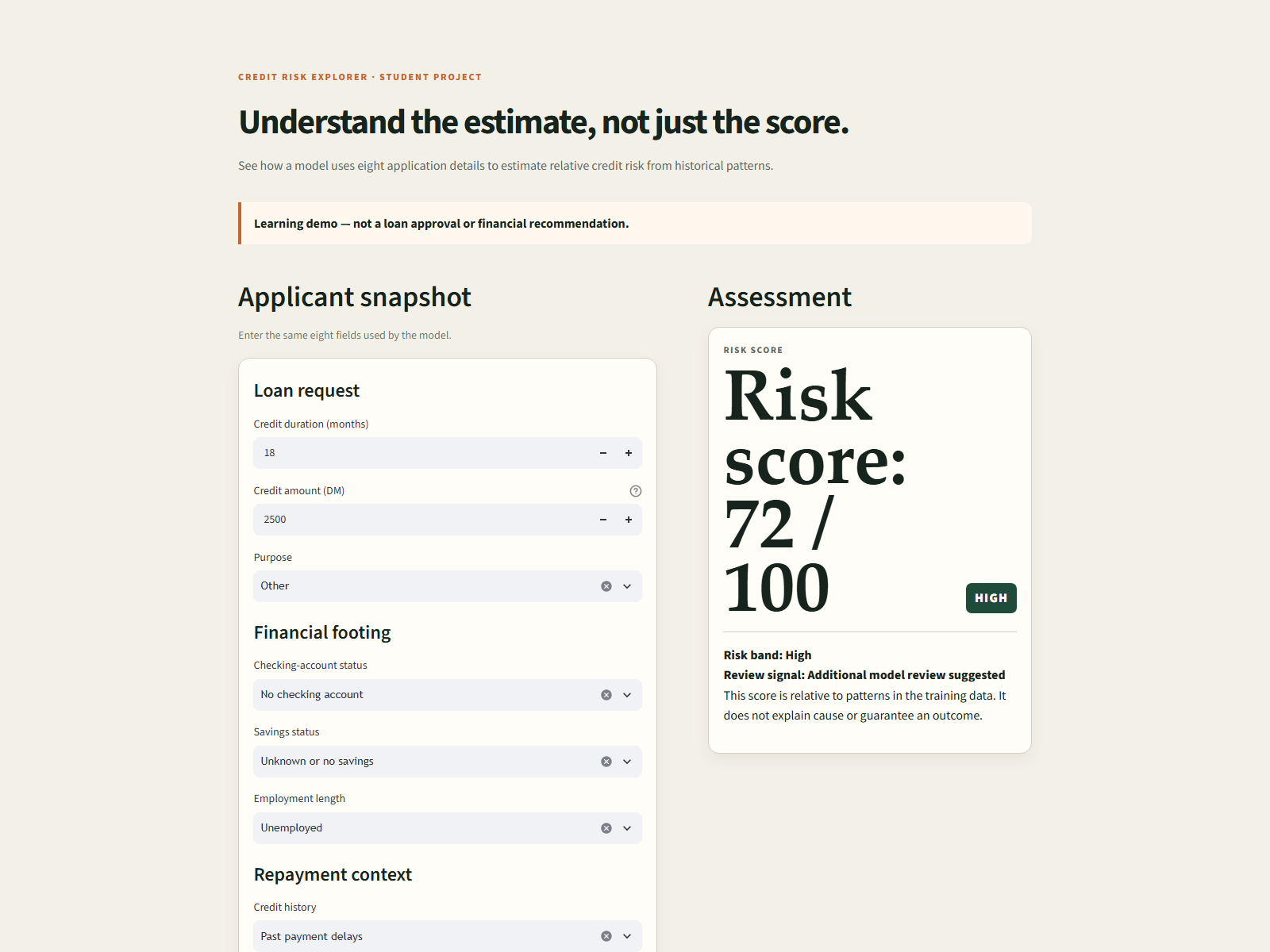
Case in one minute
- Problem
- Frontend inputs can drift from model training
- Solution
- Validate 8 fields and reuse one saved pipeline
- What I built
- Streamlit UI, preprocessing, training, and tests
- Result
- Explained output backed by 9 behavior tests
01 / Problem
Problem
A model result becomes unreliable when the interface encodes inputs differently from the training pipeline.
The app also needs to reject invalid values before inference and explain the output without presenting an educational score as a lending decision.
02 / Solution
Solution
Validate all eight inputs, then run them through the same saved preprocessing and XGBoost pipeline used for evaluation.
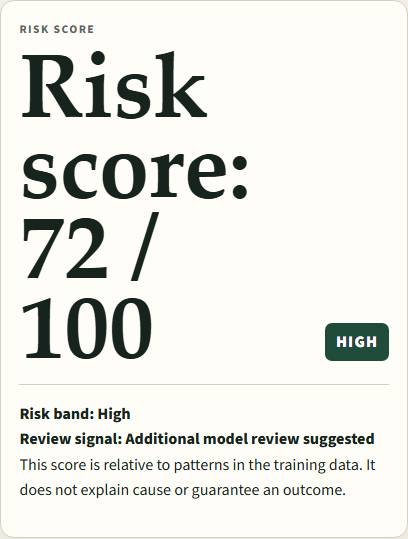
One persisted pipeline owns category encoding and prediction. The interface turns that output into a relative score, risk band, and review signal with explicit educational framing.
03 / How it works
How it works
The complete path from input to a finished, inspectable result.
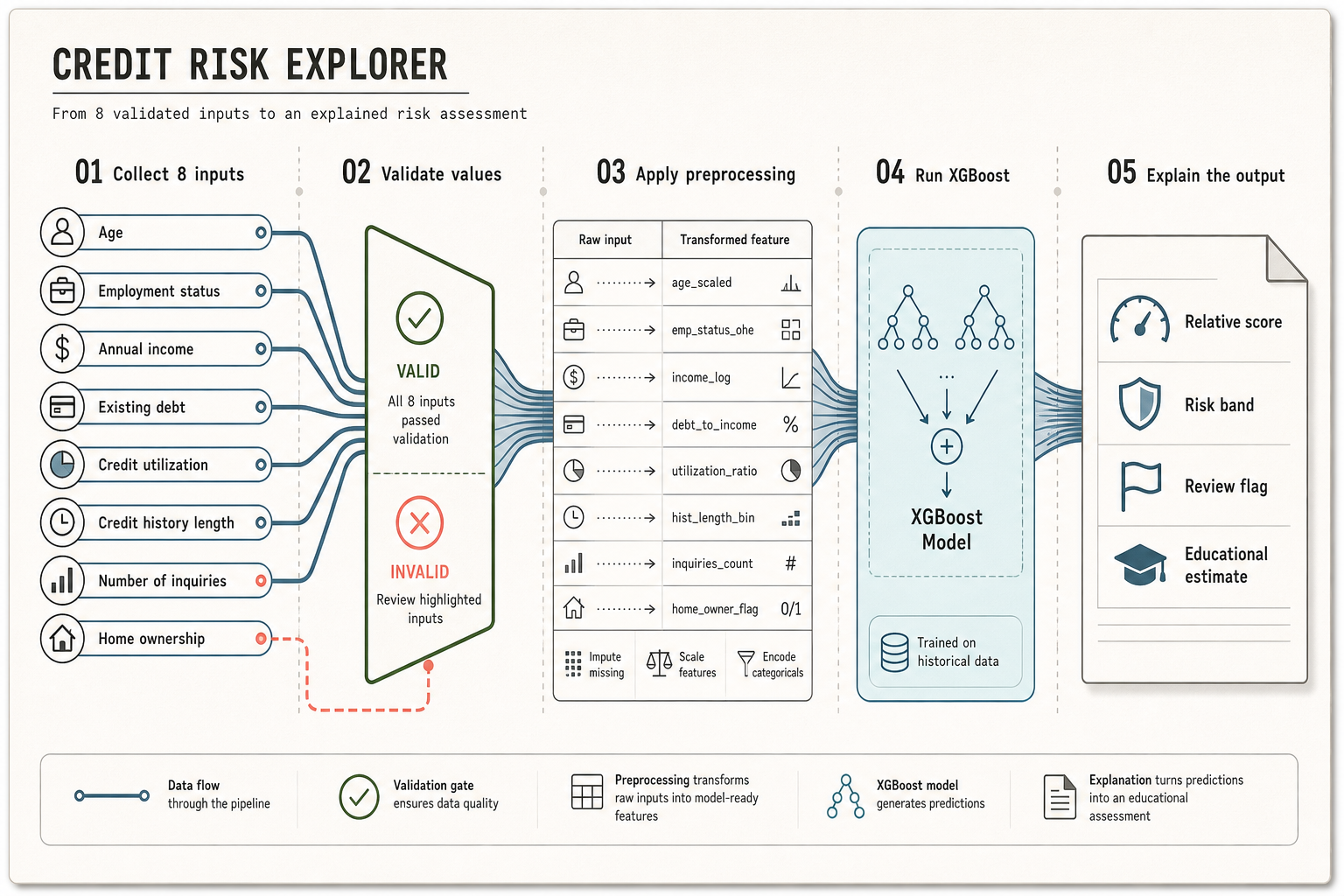
Collect 8 inputs
Capture the applicant and loan fields used during training.
Validate values
Reject missing, invalid, or out-of-range input before inference.
Apply preprocessing
Use the saved column mapping and one-hot encoding.
Run XGBoost
Load the evaluated pipeline and calculate relative risk.
Explain the output
Show the score, risk band, review flag, and educational notice.
04 / What I built
What I built
The concrete parts I designed, implemented, and tested.
Validated Streamlit interface
I built the form and result workspace for the eight model inputs, including clear invalid-input and missing-model states.
Saved inference pipeline
I implemented one scikit-learn pipeline for preprocessing and XGBoost so training and the live interface use the same transformations.
Repeatable training and evaluation
I created the deterministic stratified split, model training, saved artifact, and evaluation output for accuracy, ROC-AUC, and bad-credit recall.
Behavior-focused tests
I added tests for field mapping, split isolation, saved-model round trips, validation, missing artifacts, and frontend/backend agreement.
05 / Results
Results
What the finished system demonstrates through working behavior, tests, and project artifacts.
- A deterministic stratified 80/20 split keeps evaluation repeatable.
- The held-out run records 0.756 ROC-AUC and 71.7% bad-credit recall on 200 records.
- Nine tests cover data mapping, split isolation, saved-model round trips, validation, missing artifacts, and frontend/backend agreement.
- The interface labels the result as a relative educational estimate rather than an approval decision.